

Dialogue with the Automatic Muse
The creator's role is evolving from craftsman to conductor of algorithms. With tools handling the 'how,' human value is distilled to its essence: vision, judgment, and the ultimate 'why'.

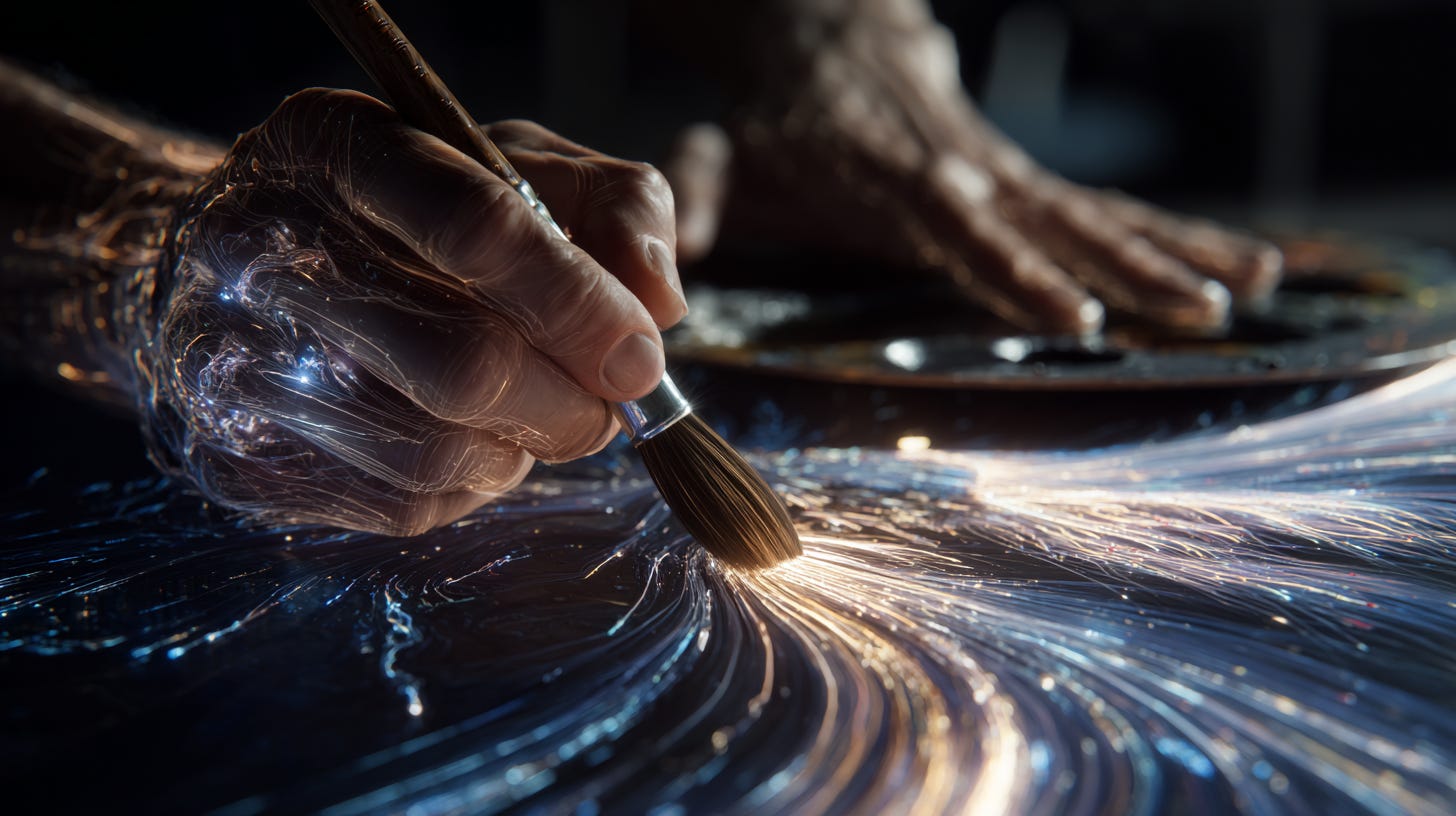
We might be witnessing a quiet metamorphosis in the creator's studio. Beside the familiar tools—those that demand the hand and the breath—new interfaces now converse in algorithmic language.
Value, once found in the intimate mastery of a medium, appears to be shifting toward a different kind of know-how. The artisan's hand is no longer alone; it is learning to guide artificial intelligences.
Perhaps skill, once defined by production, is now being redefined by connection. The creator, like a conductor, assembles fragments generated by algorithms; their talent might now be found in the ability to make once-sealed worlds converse. The role becomes less about manufacturing, and more about integration.
Yet, a new layer of abstraction is already beginning to take shape. Soon, a meta-tool—a digital stage manager of sorts—could take charge of this orchestration. A human might entrust it with an idea, and the machine alone would manage the production chain, delegating tasks to an army of specialized AIs. The creator, freed from the technical "how" and even from the assembly, is left facing the essential.
Their role, perhaps, is distilled down to two bare, irreducible functions: intention and judgment.
In this new landscape, intention emerges as the initial spark. It is the vision, the core question, the emotion to be conveyed. It is the breath that sets the powerful machinery in motion. It demands a deep-seated culture, a sharpened sensibility, a clarity of thought that no machine can yet simulate.
Judgment, for its part, could be seen as the final act. It is the eye that evaluates and makes the final call. It is the arbitration of taste, the decision that validates or rejects the algorithm's proposals—not based on criteria of efficiency, but on the intangible ones of meaning and beauty.
This leads to a fascinating paradox. The more capable the tools become, the more the human contribution seems to take refuge in its least technical strongholds. Value appears to shift from virtuosity to vision, from the hand to the soul. The risk, of course, is that of a polished aesthetic, a creation without rough edges, where the "happy accidents" of the manual process have vanished.
The artist of tomorrow, then, may be neither an artisan nor an engineer. In their dialogue with an intelligence that has mastered every "how," their entire value might ultimately lie in the one thing that, for now, escapes it: the "why."