
Images Born Without Light
The strange new life of images with no origin story.

In “When Photons Whisper,” I wrote about the extraordinary journey every particle of light completes before dying at the back of my retina or on my camera’s sensor. A photon born in the burning heart of the Sun, trapped for tens of thousands of years in an incandescent labyrinth, then released to cross the void in eight minutes, bounce off a face, and finally expire on a sensitive surface. This unbroken path seemed like the ultimate guarantee of any image: a causal chain linking the core of a star to a viewer’s emotion.
But now we’re seeing images that have never known this journey. Faces no photon has ever touched. Light that has existed nowhere but in the probabilities of a neural network.
What have we lost—or gained—by cutting this chain?
The certificate of presence
A photograph, even a bad one, is proof of an encounter. Something touched something else. The photon that bounced off that face, that day, went on to strike the emulsion or silicon. An unbroken physical link.
On set, when I point a light at an actress, I’m aiming billions of these microscopic travelers at her face. They cross the air, brush her skin, bounce according to the geometry of her cheekbones and the texture of her makeup. A tiny fraction makes it to the lens and dies on the sensor.
That death matters. It’s proof the journey happened.
The second transmutation
The journey doesn’t stop at the sensor. Or at the retina.
When a photon dies at the back of my eye, it sets off a biochemical cascade in the photoreceptor cells. That cascade travels along the optic nerve, reaches the visual cortex. And there, something extraordinary happens: light becomes something else. Information. Depth. Emotion.
I see a sad face. I sense danger in the shadow of a hallway. None of that exists in the photon itself. My brain is doing the work—turning these flashes of light into lived experience.
The painter went through this too. Photons crossed space, bounced off the world, hit his retinas, triggered the neural cascade. His brain turned those impacts into perceptions, memories. His hand moved the brush. The canvas received the imprint of a vision that was itself born from an actual journey.
Between the Sun and the canvas, the physical chain stays intact. It just passes through one more relay: the painter’s mind.
The orphan image
The AI-generated image breaks this chain.
No photon ever traveled for it. None bounced off the face it shows. It emerges from a statistical calculation, a weighted average of millions of earlier images—which themselves were born from real journeys.
AI inherits the photons’ path indirectly, through training data. But that inheritance is infinitely diluted. Millions of trajectories anonymized, averaged, dissolved into a probabilistic haze.
What the AI image lacks isn’t all light. It’s a specific light. A light that would have touched that face, that day.
The perfect fake
What’s most unsettling is how good the imitation is.
AI beautifully simulates the result of the journey without ever making it. Skin texture, specular highlights, depth of field—all there. It even reproduces the marks of the trip: motion blur, low-light grain. Evidence of a voyage that never took place.
It copies the fingerprint without ever knowing the finger.
And sometimes these images look more real than reality. More like what an image should be. The accidents are gone. Chance has been filtered out. What’s left is pure plausibility.
Nostalgia for the journey
Our fascination with the photorealism of AI images might be a kind of paradoxical nostalgia.
Why do we want these images to look like photographs? Why add film grain and optical flaws—all those marks of an actual journey—back in?
Maybe we’re trying to keep the illusion of connection alive, even after it’s been cut. Pretending the photon was there.
Early image generators made strange pictures, obviously fake. The newest ones try to vanish, to pass for what they’re not. There’s something dizzying about that. Not because it deceives—every image deceives—but because it deceives about the nature of the deception itself.
From hunter to architect
On set, I’m a photon hunter.
I set traps for light. I wait for the moment it “clicks,” that suspended instant when every particle seems to land exactly where it should. But I don’t create it. It comes from somewhere else—the Sun, the lamps, reflections off the world. My job is to catch it at the end of its journey.
The person running an image generator isn’t a hunter anymore. They order statistical arrangements to produce an image that didn’t exist anywhere before they acted. They’ve become architects of the possible.
The hunter depends on the game. The architect only needs the blueprint. The hunter works with randomness, surprise. The architect removes them. And yet both know failure—blown takes on set, prompts that go nowhere. That shared fumbling might be an unexpected common ground.
The broken link
In “The Whisper of Photons,” I wrote that every lit face becomes a kind of dialogue between the universe and our presence in the world. The photon, messenger from the cosmos, dies on the sensor after touching a piece of reality. That death is proof of an encounter.
The generated image might be the first that doesn’t know this death—because it never knew this life.
We’re entering the age of the immortal image, one that owes nothing to matter and everything to structure.
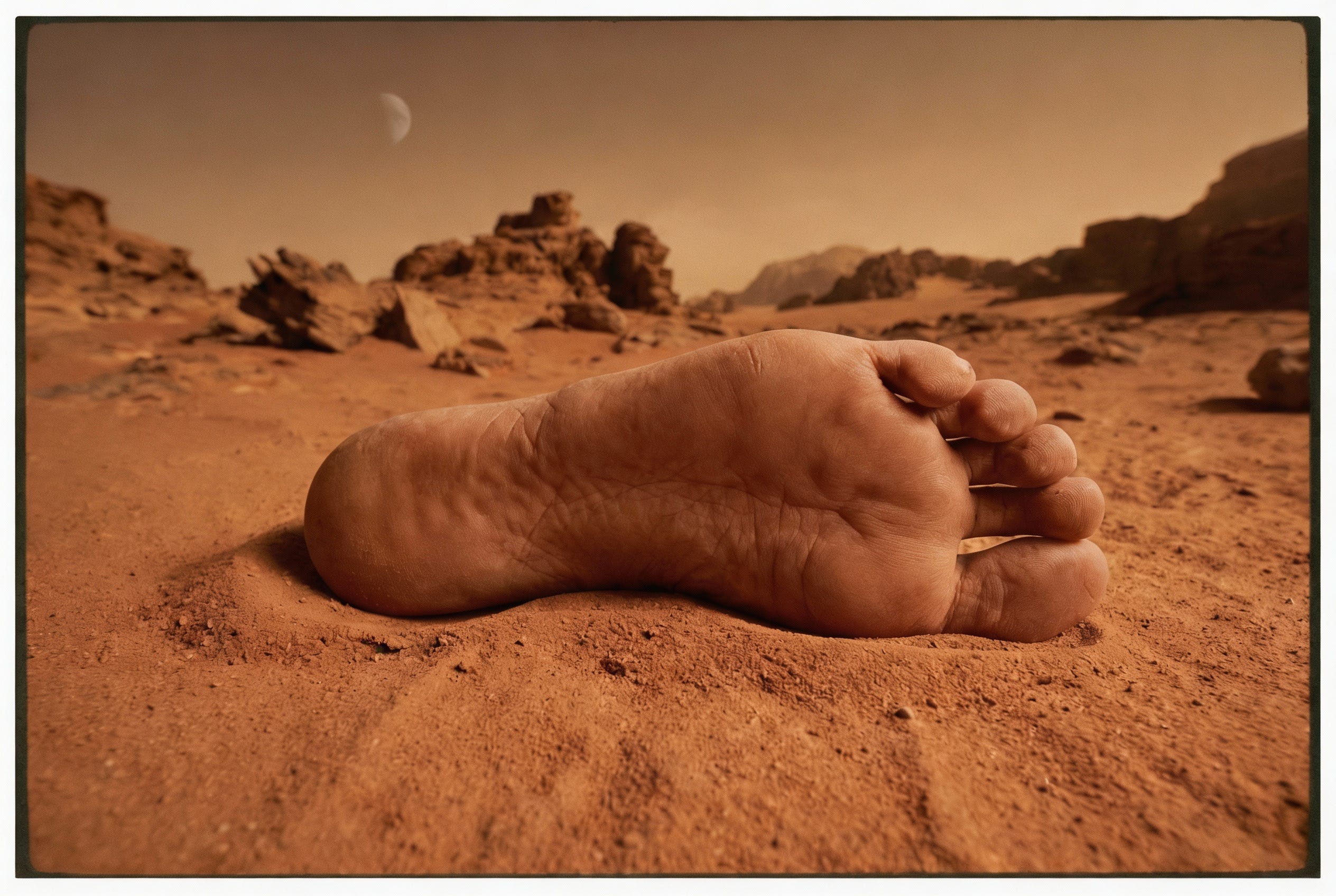
And yet something holds back. A quiet vertigo. Like finding, on the fine sand of a planet no human has ever visited, the print of a bare foot—so precise you can see the ridges of skin and the slight skid of a heel. Pushing off toward the sky.