

Unpromptable
Twelve Words and a Spaghetti Monster


Two years ago, a video of Will Smith eating spaghetti went viral, and it wasn’t because anyone thought it was good. His face melted into itself, his fingers fused, noodles phased clean through his skull. We laughed the way you laugh at something that’s almost frightening — because the machine, for all its ambition, still couldn’t figure out how a fork works.
Yesterday, someone used Seedance 2.0 to make Will Smith fight a spaghetti monster. Clean cuts, cinematic lighting, sound design that lands right on the beat. The monster has weight and texture and genuine screen presence. Smith moves like Smith. The whole thing was conjured from twelve words and took about ninety seconds to render.
Two years. That’s all the distance between the grotesque and the gorgeous.
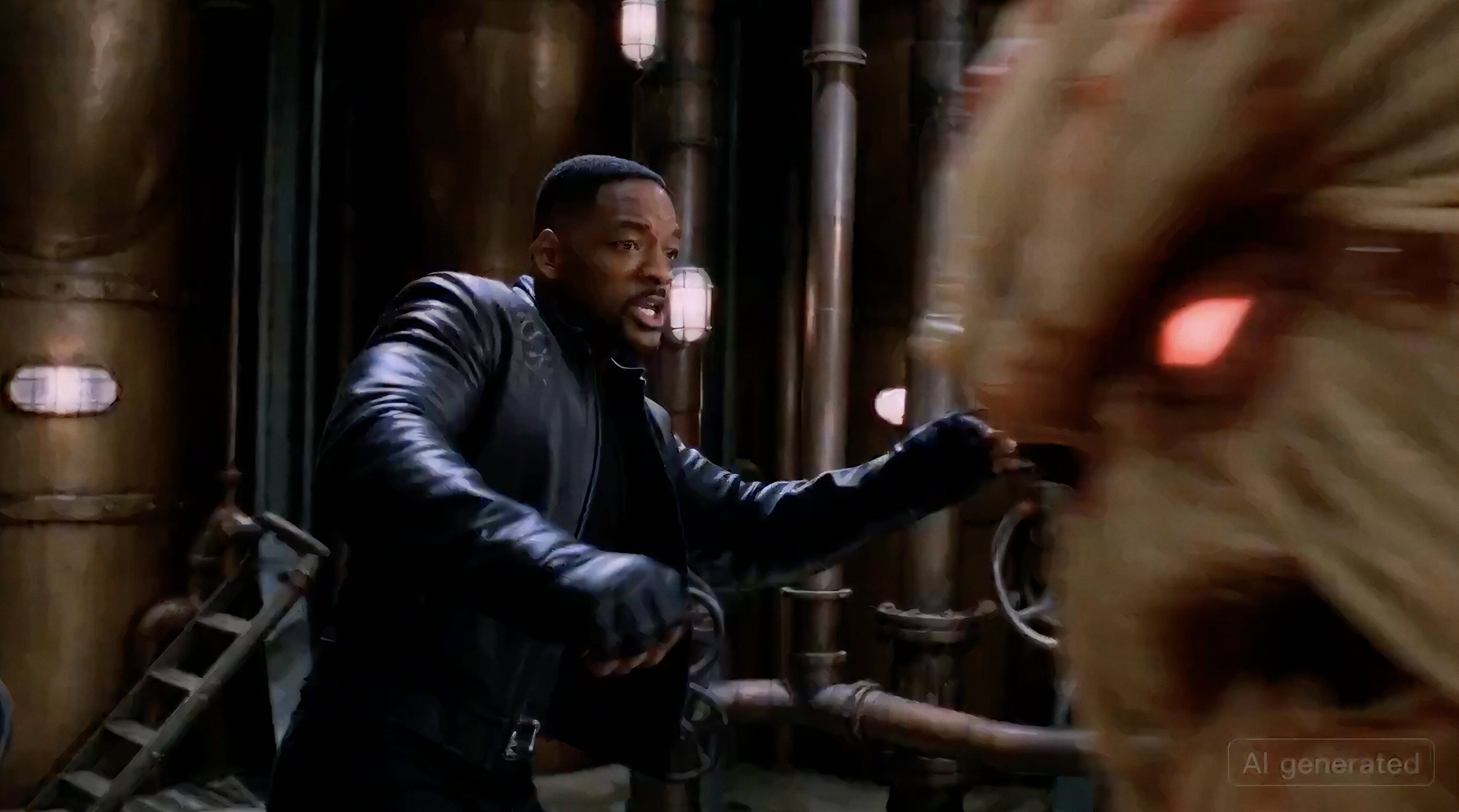
ByteDance’s new model doesn’t just produce moving images. It generates multi-shot sequences with dialogue, ambient sound, and foley in a single pass. You upload a reference clip and it replicates your camera movement, your pacing, your editing rhythm. You feed it a face and it keeps that face consistent from one shot to the next. You describe a scene in plain English and out comes something that, not long ago, would have required a crew, a location, and a week of post-production.
I’ve shot more than 350 films across four continents. I’ve hauled cameras through the Sahara, rigged lights in Tokyo alleyways, sat on a cliff in Madagascar waiting for the golden hour that never quite came the way I’d imagined it. And I can tell you that the gap between what this model produces and what a competent crew delivers is shrinking at a pace that ought to make any filmmaker sit up. Not panic — sit up.
The word
During a conversation the other day, a word came up that I haven’t been able to shake. Unpromptable. It doesn’t appear in any dictionary. It should.
The idea is simple enough. If someone can reproduce your work by typing twelve words into a text box, you haven’t really built anything. You’ve demonstrated a skill — aligning keywords and sliders — that is about to become a commodity. It gets the job done. It doesn’t build anything that lasts.
The instinct, for anyone who’s spent years learning a craft, is to add layers. If the machine generates the image, fine, I’ll do the color grading. If it handles the edit, I’ll design the sound. If it writes the music, I’ll choreograph the camera move. I’ve started calling this the Layer Trap, because every layer you add today becomes a feature the model absorbs six months from now. Seedance 2.0 already handles shot continuity, sound design, lip-sync, and camera language. The craft-as-moat strategy has an expiration date.
So what doesn’t expire?
Private cosmologies
Bergman and Kubrick shot in the same era, with the same cameras, on the same Kodak stock. They shared the same basic grammar of cinema. And yet nobody has ever confused a frame of Persona with a frame of 2001. The difference wasn’t technical. It was obsessional. Bergman saw the human face as a landscape to be explored without mercy. Kubrick saw geometry as a means of control. Those obsessions weren’t surface choices — they bled into everything, the casting, the framing, the rhythm, the particular weight of a silence. You couldn’t reverse-engineer any of it into a settings panel.
That’s what unpromptable looks like.
I think a lot, these days, about the people I was lucky enough to meet when I was young and still trying to figure out what cinema could be. Piotr Kamler, building his impossible geometries frame by frame in a tiny studio in Paris — a man who made the abstract feel like it had gravity. Ray Harryhausen, whose stop-motion creatures carried more soul in a clay eyelid than most CGI characters manage with a billion polygons. Phil Tippett, who kept pushing the boundary between puppet and nightmare long after the industry had written his professional obituary. And Moebius, drawing worlds so internally coherent you felt you could smell the air in them.
None of them ever touched AI. All of them built something no prompt could reproduce, and not because the technique was especially arcane — because the vision was specific. Kamler’s films don’t look like Harryhausen’s. Tippett’s Mad God doesn’t look like anything else, period. Each of them spent decades digging the same hole, alone, without anyone asking them to. That kind of singularity doesn’t come from tools. It comes from somewhere much harder to locate.
The unpromptable lives upstream of execution.
The fire and the spark
I’m working right now on an animated series that will take years and thousands of hours across multiple seasons — children who travel through time and cross paths with the figures who bent history. Could someone prompt a clip of that premise? Of course. But nobody can prompt the emotional architecture that connects one season to the next. Nobody can prompt thirty years of shooting across four continents bleeding quietly into how I frame a scene. Or the particular stubbornness it takes to keep building a world when the market is telling you to just ship content.
A single clip can be remade. A corpus can’t.
And here’s where the thing gets uncomfortable. When millions of people watch Will Smith fight a spaghetti monster and think it’s brilliant, the issue isn’t just the tool. It’s the audience. Unpromptable work rests on the assumption that somewhere out there is a viewer who can feel the difference between depth and surface, between a vision and a decoration. What if most viewers can’t tell? Or worse — what if they can, but simply don’t care?
The economics of attention reward what’s shareable, not what’s irreducible. And Seedance 2.0 is a shareability engine of extraordinary power. Twelve words, ninety seconds, millions of views. The math is not gentle.
None of this makes the unpromptable irrelevant. But it does make it a choice — a deliberate positioning against the current, with all the risk that entails. It’s a bit like being a jazz musician. The music is no less profound in 2026 than it was in 1959. The ecosystem has simply shifted around it.
A compass, not a manifesto
I’ve been testing three things against every project I take on, and so far they hold.
The first: never put out a piece that doesn’t carry a question I’d ask in my own way — shaped by what I’ve lived, what I’ve seen, and what I’ve cared about long enough for it to leave a mark.
The second: treat every project as a brick in an ongoing architecture. The unpromptable isn’t any single work. It’s the accumulated weight of a trajectory that can’t be flattened into a prompt.
The third: use the machine the way I use a light source or a camera. It doesn’t create what I’m looking at. It reveals it. But the choice of where to aim, when to roll, and what to leave in shadow — the light I waited three hours for, the angle that came to me in a dream I had in Antananarivo — that part is mine.
I keep pulling at three threads and none of them come loose.
If the machine eventually learns to simulate intention — to produce work that genuinely appears to have a point of view — will we be able to tell the difference between the authentic and the performed? And will that distinction matter to anyone outside the small tribe of people who make things for a living?
Does the unpromptable demand entirely new formats — hybrid, spatial, performative forms that escape the rectangle of the screen — or can it hold its ground within the very formats the machine has already mastered?
And the one that keeps me up at night. Maybe the whole idea of the singular artist is what’s reaching its expiration date. Maybe what’s coming isn’t a war between craftspeople and machines, but something stranger and harder to name — a vast, churning, collective pop culture generated by billions of humans armed with twelve-word prompts, where authorship dissolves and copyright fades into a quaint memory.
An enormous creative disorder in which everyone remixes everything, nobody signs anything, and the notion that one person’s vision should matter more than another’s simply stops making sense. It’s not good or bad. It’s just somewhere else entirely.
And the question isn’t whether the unpromptable can survive in that world. It’s whether that world still needs it to.
such an inspiring article! Thanks for that! Glad I found it! =)